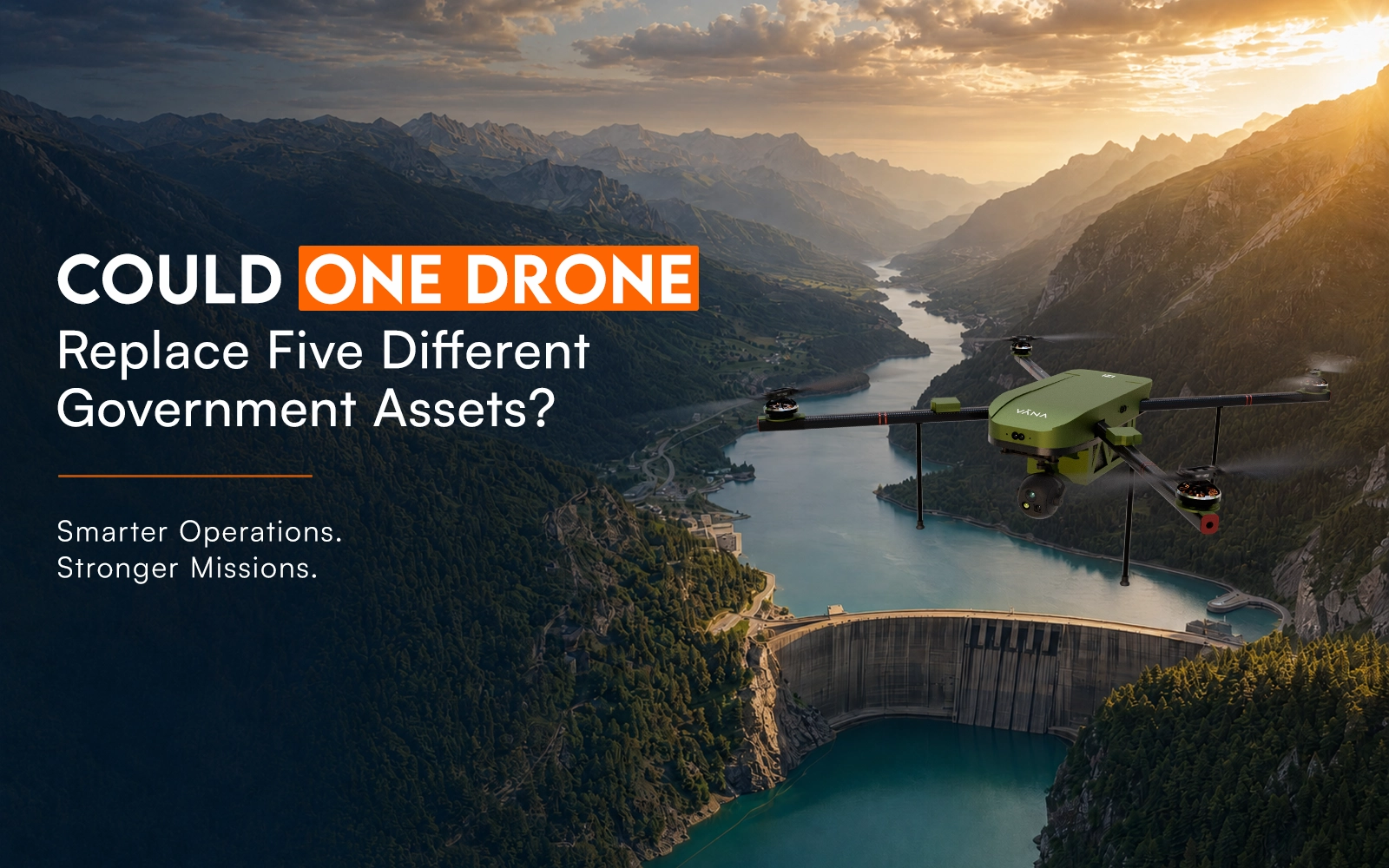
The future of aerial operations may not be about buying more platforms. It may be about building smarter ones.
For decades, the answer to a new operational challenge was surprisingly simple.
Buy another machine.
A new inspection requirement called for a specialised inspection platform. Mapping projects demanded a different aircraft. Surveillance required another system altogether. Training often happened on separate platforms, while emergency response introduced yet another fleet into the mix.
Viewed individually, each procurement made perfect sense.
Viewed collectively, they created a problem that was far more difficult to manage than the missions they were originally purchased to perform.
Today, governments and enterprises across the world are beginning to ask a different question.
Instead of buying another platform, could the same platform adapt to another mission?
It is a subtle shift in thinking, but one that has the potential to redefine how aerial operations are planned, deployed, and sustained.
Infrastructure Is Growing Faster Than Operational Complexity Can Keep Up
India is expanding at an unprecedented pace.
New highways are connecting regions that were once separated by hours of travel. Railway corridors are becoming smarter and faster. Transmission networks are stretching across thousands of kilometres, while renewable energy installations, industrial parks, ports, and logistics hubs continue to grow.
Every one of these assets demands continuous monitoring.
Transmission lines need inspection.
Railway tracks require routine assessment.
Road corridors must be documented.
Construction progress needs verification.
Flood-prone regions have to be mapped before disasters strike.
Forests require environmental monitoring.
Law enforcement agencies need aerial situational awareness during large public gatherings.
Although these missions look different on paper, they often require the same fundamental capability.
A reliable way to observe, document, analyse, and respond.
Yet historically, each requirement has led to another specialised platform entering the fleet.
The Hidden Cost Isn’t Procurement. It’s Everything That Comes After.
When organisations evaluate a new aerial system, attention naturally gravitates towards specifications.
Flight time.
Camera quality.
Range.
Payload.
But these are only the beginning of the story.
The real investment begins after the purchase order is signed.
Every additional platform introduces its own operator training programme, maintenance procedures, spare parts inventory, software ecosystem, firmware updates, batteries, support contracts, and certification requirements.
Multiply that across multiple departments and multiple aircraft, and operational complexity grows much faster than capability itself.
A fleet of specialised systems may solve individual problems exceptionally well.
Managing that fleet, however, becomes a challenge of its own.
This is why organisations around the world are placing greater emphasis on lifecycle costs rather than acquisition costs alone. The discussion is no longer centred on buying an aircraft. It is increasingly focused on managing an ecosystem over the next five or ten years.
The Best Technology Often Does More, Not More Things
Think about the smartphone in your pocket.
Not very long ago, we carried separate devices for navigation, photography, music, communication, payments, and internet access.
Today, one platform performs all of those functions because its software and hardware adapt to different needs.
The same principle is quietly reshaping enterprise aviation.
Instead of designing entirely different aircraft for every operational scenario, manufacturers are moving towards common aerial platforms that can be configured for different missions through interchangeable payloads, specialised sensors, and mission-specific software.
The aircraft remains familiar.
The mission evolves.
That change may sound incremental.
Operationally, it changes everything.
Training becomes simpler because operators learn one platform instead of several.
Maintenance becomes easier because fleets share common components.
Logistics become more predictable.
Procurement becomes more efficient.
And organisations gain the flexibility to respond to changing operational requirements without continuously expanding their inventory.
One Platform. Multiple Missions.
This philosophy is becoming increasingly relevant for government agencies responsible for infrastructure, utilities, public safety, disaster response, environmental monitoring, and strategic operations.
A mapping mission conducted today may be followed by a railway inspection tomorrow.
The following week could involve flood assessment, powerline inspection, or supporting emergency response teams during a natural disaster.
The objective is not to build a different aircraft for every situation.
It is to build a platform capable of adapting as those situations change.
This shift is encouraging organisations to think less about fleets and more about capability.
Instead of asking, “Which drone do we need?”
They are beginning to ask,
“Which platform can support the missions we haven’t even planned yet?”
Where VANA Fits Into This Conversation
This philosophy forms the foundation of VANA, IZI Enterprise’s modular UAV ecosystem.
Rather than approaching aerial operations as a collection of independent products, VANA has been designed around a common platform architecture capable of supporting multiple mission profiles through configurable payloads, intelligent software workflows, and mission-specific configurations.
The same aerial platform can be adapted for mapping, infrastructure inspection, surveillance, environmental assessment, training, and a range of enterprise applications without requiring organisations to manage entirely separate fleets for every operational requirement.
The objective is straightforward.
Reduce operational complexity.
Increase mission flexibility.
Help organisations scale capabilities instead of inventories.
Because in large deployments, the value of a platform is measured not only by what it can do today, but by how easily it can adapt tomorrow.
The Future Belongs to Platforms, Not Products
Every generation of technology eventually reaches the same turning point.
The conversation moves away from individual devices and towards systems that are simpler to operate, easier to maintain, and flexible enough to evolve alongside changing needs.
Enterprise UAVs are entering that phase today.
Success will no longer be defined by how many specialised aircraft an organisation owns.
It will be defined by how effectively one platform can support multiple missions, multiple departments, and multiple years of operation.
Because innovation isn’t always about building another machine.
Sometimes, it’s about building one that makes several others unnecessary.