The strategic independence of a nation is measured not simply by the weapons it owns, but by its ability to understand, maintain and evolve the technologies on which its security depends.
A defence planner does not think about technological dependence in the abstract. The question becomes concrete when a system needs a replacement component, when a new operating environment demands a different configuration, when software must be modified or when equipment has to remain available despite a disruption in the supply chain. At that moment, the distinction between owning a system and controlling its future becomes difficult to ignore.
Drones bring this question into particularly sharp focus. They combine airframes, sensors, navigation, communications, software, batteries and control systems in a compact package. Their performance depends on the way these elements work together, and their usefulness can change as the mission, the environment or the technology itself changes. A country may be able to purchase a capable drone, but the ability to adapt and sustain that drone is a different form of power.
For India, this distinction is becoming central to the debate about defence modernisation. The country has made significant progress in expanding domestic defence manufacturing, encouraging private-sector participation and developing indigenous technologies. Yet the next phase of self-reliance will demand more than increasing the number of platforms assembled or produced within the country. It will require deeper expertise in the systems that make those platforms work, the software that governs them, the supply chains that sustain them and the engineering decisions that determine how readily they can evolve.
The question is no longer simply whether India can build a drone. It is whether India can build a drone capability that remains under meaningful Indian control throughout its operational life.
The new economics of military dependence
For much of the history of modern defence, technological dependence was often accepted as the price of acquiring advanced equipment. Countries bought aircraft, radar systems, communications equipment and other platforms from established manufacturers because developing them independently could take years and require enormous investment. In many cases, such purchases remain necessary. No country can reasonably expect to develop every technology it uses.
But the economics of dependence become more complicated when equipment relies on tightly integrated software, specialised components, proprietary maintenance arrangements and systems that must evolve rapidly in response to changing threats.
The purchase price tells only part of the story. A system may be affordable to acquire but expensive to maintain. A component may be available today but difficult to source during a disruption. An upgrade may depend on a manufacturer whose priorities do not align with those of the operator. Even where the equipment performs well, limited access to its underlying architecture can restrict how it is modified, integrated or supported.
These are not arguments against international procurement. They are arguments for understanding the consequences of it.
In a strategic environment, the ability to sustain equipment can matter as much as the ability to acquire it. A platform that cannot be maintained, repaired or adapted when required offers a narrower form of operational independence than one whose critical systems can be understood and supported domestically.
Drones make this issue especially relevant because the technology is evolving across several interconnected areas. Sensors are becoming more sophisticated, autonomy is changing how missions are conducted, and communications and navigation systems must contend with increasingly demanding operating environments. A drone designed around a rigid architecture may become difficult to adapt as these requirements change. A platform built with a clear and configurable architecture can offer a more flexible foundation, provided its critical components and interfaces are accessible and supportable.
The lesson is straightforward: technological sovereignty cannot be measured by the location of final assembly alone. It must also be measured by the depth of control a country retains over the technology it fields.
India has built momentum. The harder work begins now.
The scale of India’s defence manufacturing expansion is significant. According to the Ministry of Defence, domestic defence production reached a record ₹1.78 lakh crore in financial year 2025–26, while defence exports rose to ₹38,424 crore. The government reported that exports had grown more than 56-fold from ₹686 crore in 2013–14. The figures are available in the Ministry’s official account of India’s defence production and exports.
These numbers reflect a changing industrial base. They indicate that Indian companies are producing more defence equipment and reaching a wider international market. They also create an opportunity to develop capabilities that extend beyond manufacturing established designs.
The policy direction is explicit. Addressing the National Defence Industries Conclave in March 2026, Defence Minister Rajnath Singh called for India to become a global hub for indigenous drone manufacturing, linking the development of a domestic production ecosystem to strategic autonomy and defence preparedness. The Ministry of Defence announcement also highlighted the role of start-ups, small businesses and innovators in the wider defence technology ecosystem.
The distinction between manufacturing and technological ownership matters here. A growing factory base can increase output and create jobs. An ecosystem capable of original design, testing, software development, component engineering and long-term support can do something more consequential: expand the country’s ability to decide how its defence technology develops.
That requires investment in research, access to testing infrastructure, sustained relationships between manufacturers and users, and procurement processes that reward useful innovation rather than treating the lowest acquisition price as the only meaningful measure of value.
It also requires patience. Indigenous capability cannot be created by a policy announcement or a single successful prototype. It emerges through repeated testing, engineering revisions, production experience and the difficult process of making a system dependable enough for the environment in which it will operate.
For India’s drone industry, this is the real opportunity. The objective should be to move from being a market that adopts aerial technology to becoming a country that can develop, integrate and sustain the systems on which its users depend.
The drone is only the visible part of the technology
A drone is easy to recognise. Its architecture is harder to see.
Beneath the airframe lies a network of technologies that determines how the system navigates, communicates, senses its surroundings, carries out a mission and responds when conditions change. A camera may provide the image, but navigation determines where the platform can operate. Communications connect the drone to its operator. Software brings together mission planning and control. Payload integration determines which information the system can collect. Maintenance and engineering support determine how long the platform remains useful.
If these capabilities are treated as unrelated components, the result can be a collection of equipment that works adequately in isolation but becomes difficult to sustain as a complete system. If they are considered together from the beginning, the design can be better aligned with the needs of the operator.
This is one reason the architecture of a drone matters. A common platform can be configured for different tasks through appropriate payloads and mission-specific equipment. Instead of requiring an entirely separate platform for every application, a manufacturer can retain a shared foundation while adapting the system to the work it must perform.
That approach does not eliminate the need for specialised equipment. A surveillance mission, a mapping operation and an inspection task may require different sensors and different methods of interpreting the data. Nor does modularity automatically establish technological sovereignty. The degree of independence depends on who controls the design, the interfaces, the software and the components that make the system function.
But a well-designed modular architecture can provide an important starting point. It can make adaptation more deliberate, simplify aspects of maintenance and training, and allow a platform to accommodate changing requirements without forcing the operator to replace the entire system.
For defence manufacturers, this is a more demanding engineering proposition than simply assembling a drone around a set of purchased components. It requires an understanding of how the components interact, how the system behaves under different conditions and how future modifications can be introduced without compromising the existing platform.
For a country seeking strategic autonomy, that understanding is part of the capability it needs to build.
Why the architecture behind VANA matters
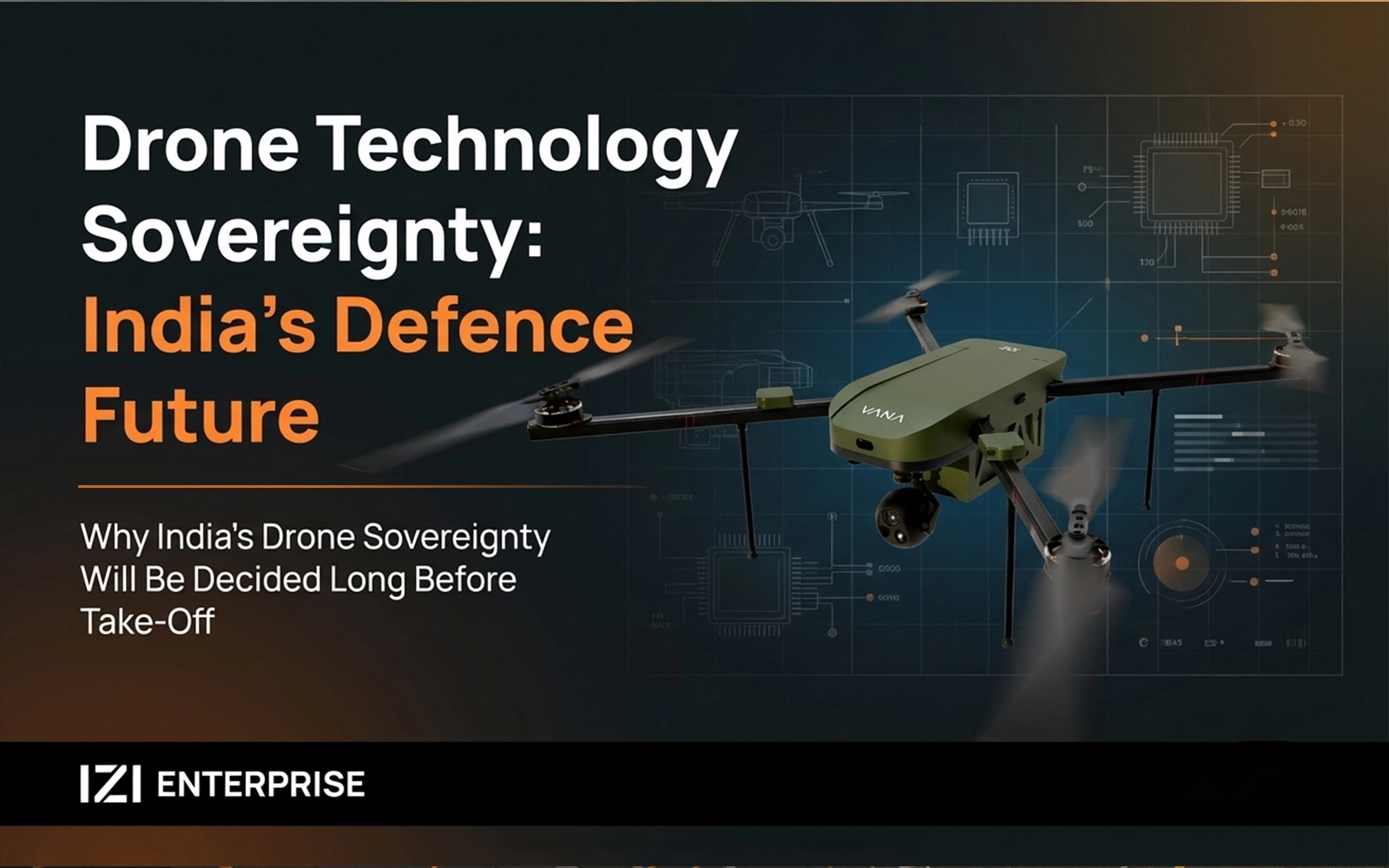
The design philosophy behind IZI VANA, IZI Enterprise’s modular unmanned aerial vehicle platform, reflects this wider question of how a drone should be developed for changing operational requirements.
VANA is designed around a common platform architecture that can be configured for different missions through modular payloads, communications and operating arrangements. Its documented applications include intelligence, surveillance and reconnaissance, border surveillance, tactical reconnaissance, mapping and disaster response. The platform documentation describes an endurance benchmark of approximately 90 minutes, along with hot-swappable payload and battery architecture intended to reduce the time required to prepare the system for its next mission.
The significance of this design is not that one configuration can perform every task. It is that a shared foundation can support different requirements without treating each new mission as an entirely separate engineering problem.
The platform’s documented payload options include electro-optical and infrared surveillance, thermal imaging, laser rangefinding, mapping and multispectral applications. Its architecture also incorporates navigation and communications capabilities intended for demanding operating environments, alongside a ground control system and mission planning and control software.
These capabilities belong to a larger engineering picture. A drone designed for defence and strategic applications must bring together the airframe, sensors, navigation, communications and control systems in a way that suits the mission. It must also be capable of being supported and adapted as requirements change.
VANA’s common architecture offers a useful example of that design philosophy. A configurable platform can provide a foundation for mission-specific equipment while retaining a consistent basis for operation and support. Over time, this can be relevant to training, maintenance, equipment utilisation and the integration of new payloads.
The strategic implications, however, depend on more than the platform’s modularity. Genuine technological independence requires the ability to understand and maintain the underlying system, control critical interfaces and software, and sustain the components on which its operation depends. These are questions that must be assessed across the entire development and support chain.
That is why the discussion about indigenous drones should extend beyond the origin of the finished product. The more important question is how much engineering knowledge, design authority and long-term support capability exists within the country that fields the system.
VANA is part of that broader conversation. Its relevance lies in the attempt to build a configurable aerial platform around a common architecture, an approach that places adaptability and mission requirements at the centre of system design.
Sovereignty is tested after the contract is signed
The most revealing measure of a defence technology programme is not always available at the moment of procurement. It emerges later, when the equipment is in service and the original assumptions meet operational reality.
A sensor may need to be replaced. A new payload may become necessary. The user may identify a weakness in the way information is delivered to the ground. A software update may be required, or a component may become difficult to source. The operating environment may change in ways the original design did not anticipate.
At that point, the depth of the domestic engineering ecosystem becomes visible. Can the manufacturer understand the problem and develop a solution? Can the system be modified without waiting indefinitely for an external supplier? Can the necessary parts be sourced, tested and integrated? Can the platform be maintained without allowing avoidable downtime to become a persistent limitation?
These questions are not unique to drones, but the pace of development in unmanned systems makes them especially important. A platform’s service life may span several generations of sensors, communications equipment and software. Its continued usefulness will depend partly on whether the architecture can accommodate change.
This is where the economics of a common platform become strategically relevant. A design that supports configurable payloads and a consistent operating foundation can help reduce unnecessary fragmentation across a fleet. It may also create opportunities to standardise aspects of training, maintenance and support. The actual benefits depend on the platform’s implementation, the extent of commonality and the needs of the operator.
For the manufacturer, the responsibility does not end when the equipment leaves the factory. It includes the ability to support the system, learn from its use and incorporate improvements in a disciplined way.
For the customer, procurement should therefore consider the entire lifecycle. Acquisition cost remains important, but so do the availability of spares, the quality of technical support, the ability to integrate new capabilities and the degree of control retained over critical technologies.
For policymakers, the implication is equally clear. If India wants a more sovereign drone industry, procurement and industrial policy must create room for domestic companies to develop original technology, test it rigorously and improve it through sustained engagement with users. The objective should not be domestic manufacture at any cost. It should be domestic capability that delivers dependable operational value.
The strategic value of being able to adapt
Technological sovereignty is sometimes discussed as though it were a destination: a point at which a country has eliminated all external dependencies. In practice, it is better understood as a continuing capacity to make informed choices about those dependencies.
A country with a strong domestic engineering base can decide which technologies must be developed internally, where partnerships make sense, which supply-chain risks require mitigation and which systems need greater control. It can make those decisions with a clearer understanding of the consequences, rather than relying on assumptions about equipment it does not fully understand.
In drones, that capacity extends across the platform, payloads, software, navigation, communications and support infrastructure. It also includes the people who design, test, operate and maintain the systems. Hardware without engineering depth is difficult to evolve. Software without an understanding of the platform can be difficult to integrate. Manufacturing without long-term support can produce equipment that becomes less useful as it ages.
India’s growing defence industry offers an opportunity to bring these capabilities together. The next stage of progress will depend on whether domestic manufacturers can turn production momentum into original design expertise, reliable systems and a sustainable base of technical knowledge.
That is a harder ambition than simply increasing output. It is also the one that matters most.
The future of India’s drone industry will not be determined solely by how many platforms it produces or how quickly it can deliver them. It will be determined by whether the country can continue to improve those systems, understand their limitations, secure their operation and support them when the demands placed upon them change.
For IZI VANA, the common-architecture approach offers one way to engage with that challenge. For India, the larger task is to build an industrial and technological ecosystem capable of sustaining such systems on its own terms.
A country does not become technologically sovereign merely by owning the machines it needs. It moves closer to sovereignty when it possesses the knowledge and industrial capacity to decide what those machines become next.