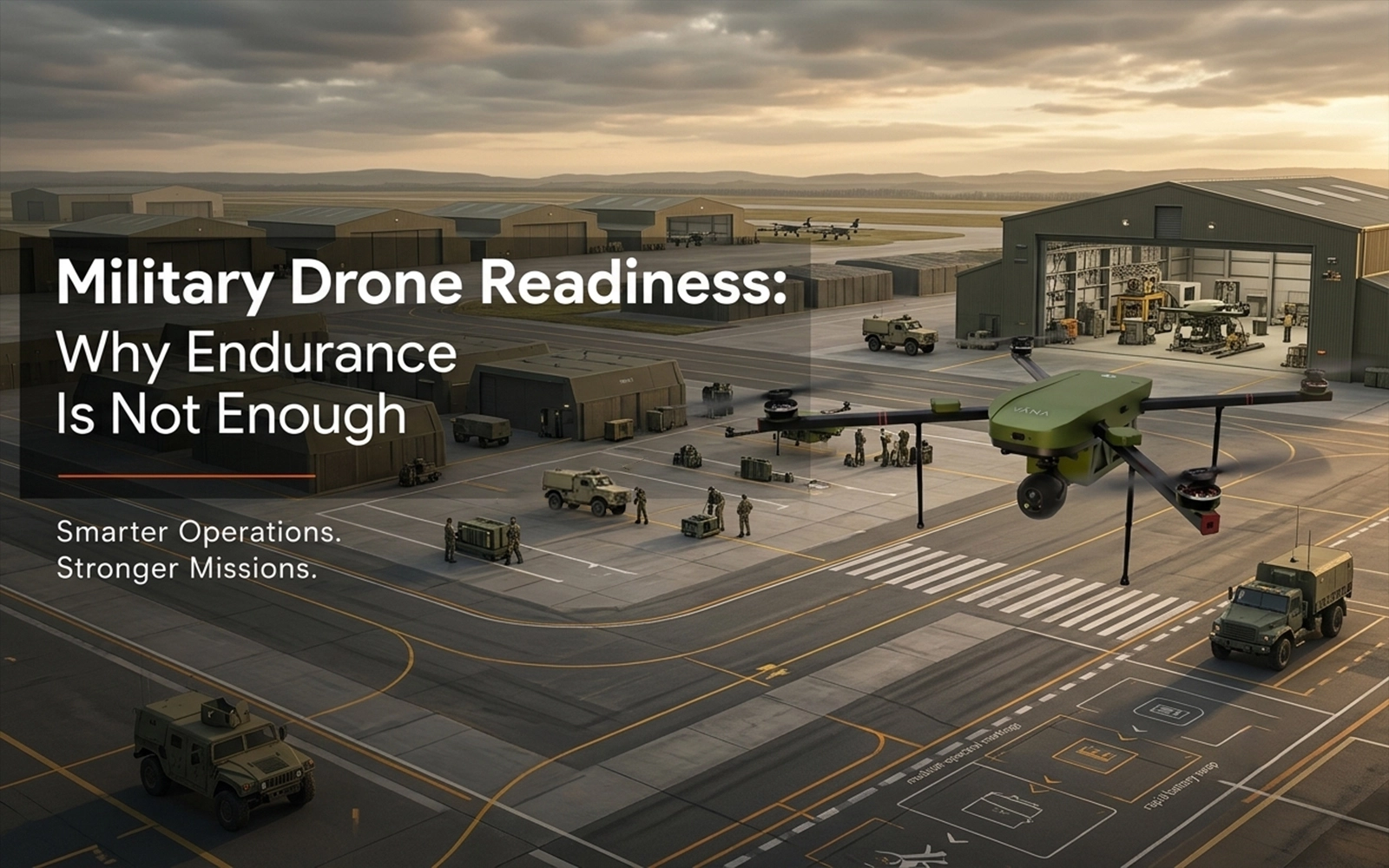
A military drone’s performance is often discussed in terms of what happens after take-off. How long can it remain airborne? How far can it travel? What payload can it carry? How effectively can it transmit information? These are essential questions, but they leave out a part of the operational cycle that can be just as consequential: what happens after the drone returns to the ground.
The aircraft must be inspected. Batteries may need to be replaced or recharged. Payloads may need to be changed. Equipment must be checked, data reviewed and the system prepared for its next assignment. If the next mission requires a different configuration, additional time and technical intervention may be involved. The interval between two flights is therefore not an administrative pause. It is part of the system’s operational performance.
This distinction becomes important when drones are expected to support repeated missions rather than occasional deployments. A platform may offer substantial endurance during an individual flight, but that figure alone cannot tell an operator how consistently it can be made available. A drone that performs well in the air but requires complicated preparation between missions may not deliver the level of availability that its user needs.
For military organisations, readiness is not an accessory to capability. It is what makes capability available when required.
The growing use of unmanned systems has brought this question into sharper focus. Drones are now being considered for surveillance, reconnaissance, mapping, infrastructure monitoring and a widening range of specialised roles. As their use expands, the challenge shifts from acquiring individual platforms to managing the systems, people and support arrangements required to keep them operational.
India’s next stage of drone development must account for this wider requirement. The question is not only how capable a drone is when it leaves the ground. It is how effectively the platform, its supporting equipment and the organisation operating it can sustain repeated missions.
Flight endurance is not the same as operational availability
Endurance is a straightforward performance measure. It indicates how long a drone can remain airborne under specified conditions. For a surveillance mission, a longer flight can allow an operator to observe an area for an extended period without having to bring the system back immediately.
Operational availability addresses a different question: whether the system is ready to perform its assigned task when required. It is influenced by maintenance, battery condition, spare-part availability, payload configuration, technical checks, operator readiness and the time required to prepare the platform for another flight.
Consider a unit assigned to monitor a sensitive area over an extended period. A drone with a long flight window can provide substantial observation during its mission. But the requirement may continue after it lands. The unit may need to repeat the observation, shift its focus to another location or configure the system for a different task. If the preparation process is complicated, the interval between missions can become a limitation.
This is why endurance and availability should not be treated as interchangeable measures. One describes the duration of an individual flight. The other concerns the ability to make the system available repeatedly, in the required condition and configuration.
The difference becomes even more significant when an organisation operates multiple drones across different locations. Every additional platform type, payload interface, battery arrangement and maintenance procedure adds to the work required to manage the fleet. The acquisition of more systems does not automatically produce a more capable force if those systems are difficult to operate and sustain.
The cost of a system does not end at procurement
The financial commitment involved in a military platform extends well beyond its initial purchase. Repair parts, maintenance, technical personnel, software support, training, logistics and infrastructure all contribute to the cost of keeping a system operational.
The United States Government Accountability Office has repeatedly highlighted the importance of these expenses. In its April 2026 report on weapon-system sustainment, the GAO states that operating and support costs account for approximately 70 per cent of a weapon system’s total lifecycle cost. The figure relates to weapon systems broadly, including aircraft, ships and combat vehicles, rather than drones specifically. Nevertheless, it illustrates why acquisition price alone is an inadequate measure of long-term value. U.S. Government Accountability Office, Weapon System Sustainment, April 2026.
For unmanned systems, the issue is particularly relevant because the technology is evolving quickly. Sensors, communication systems, navigation, software and mission requirements can change within a relatively short period. A platform that cannot accommodate modifications without substantial redesign may become difficult to maintain or adapt as the user’s requirements evolve.
This creates a challenge for defence procurement. A system should not be evaluated only on whether it satisfies the requirement for which it was initially acquired. Its architecture, support arrangements and upgrade potential also influence whether it will remain useful over its intended service life.
The procurement process, in other words, should consider the complete operating cycle. A lower initial acquisition cost may not translate into lower long-term expenditure if the platform requires extensive maintenance, specialised support or frequent replacement of components. Equally, a technically sophisticated system may prove difficult to sustain if its supply chain and maintenance arrangements are not adequately developed.
The lesson is not that every drone must be designed for every possible future requirement. It is that maintainability and supportability should be considered at the beginning of the design process, not treated as problems to be solved after procurement.
Why modularity matters beyond payload selection
Modularity is often presented as the ability to change a drone’s payload. That is an important feature, but its wider significance lies in how it can influence the organisation operating the system.
Different missions demand different equipment. A surveillance operation may require electro-optical or infrared sensors. Mapping may require a different imaging configuration. An inspection assignment may have its own requirements for data collection and telemetry. If every mission requires a separate airframe, the operator must manage multiple platforms, maintenance pipelines, spare-part inventories and training procedures.
A common platform architecture offers a different approach. It allows a defined range of mission configurations to be built around a shared foundation. The airframe and core systems provide continuity, while payloads and other compatible components can be selected according to the task.
The operational advantage is not simply that a sensor can be changed. It is that the organisation may be able to support several mission requirements without multiplying the number of entirely separate systems it has to maintain.
This is the principle behind IZI VANA’s configurable architecture. The platform is designed around a common aerial foundation that can support different mission segments through modular configurations and interchangeable payloads. Its intended applications include ISR and surveillance, inspection, mapping and other mission-critical operations.
A common architecture can also influence the way training and maintenance are organised. When different configurations share core systems and operating principles, organisations have an opportunity to reduce unnecessary variation in their procedures. The extent of that advantage depends on how much commonality exists between configurations and how effectively the manufacturer supports them.
Modularity should not be mistaken for universal compatibility. Not every payload will suit every mission, and not every configuration will be appropriate for every operating environment. The real value lies in the ability to adapt the platform within a defined and validated range of requirements.
The ground between two missions matters
Battery management is one of the most practical examples of how design decisions influence operational readiness.
A drone’s flight endurance tells the operator how long it can remain airborne. But a unit conducting repeated missions must also manage battery availability, charging, storage, battery condition and replacement. These requirements influence how many systems can be kept ready and how effectively a deployment schedule can be maintained.
A hot-swappable battery architecture can simplify one part of this process. By allowing a battery to be replaced through a designed changeover mechanism, it can reduce the need for more involved disassembly and make the transition between missions more straightforward.
This does not mean that the drone can be relaunched immediately after every landing. Pre-flight checks, post-flight inspections, battery health assessments and other safety procedures remain necessary. Nor does a hot-swappable design eliminate the need for sufficient batteries, charging infrastructure and trained personnel. Its value is more specific: it can make battery replacement a less complicated part of the preparation cycle.
VANA incorporates a hot-swappable battery architecture alongside modular payload integration. These design choices address two practical parts of the ground cycle: preparing the power system for another flight and configuring the platform for a defined mission requirement.
The same principle applies to payloads. A platform designed around a universal payload interface can provide a more structured way to integrate compatible mission equipment. This can help avoid treating every new sensor requirement as a separate platform-development exercise.
The distinction is important. Operational readiness is not created by one component. It emerges from the relationship between the platform, its batteries, payloads, maintenance procedures, support equipment and operators.
India’s drone ecosystem must learn to sustain what it builds
India’s growing defence drone industry is often discussed through the lens of manufacturing capacity and indigenous technology. Both are important, but the next challenge is to ensure that domestically developed systems can be supported throughout their operational lives.
The Ministry of Defence has placed considerable emphasis on building this wider ecosystem. At the National Defence Industries Conclave in March 2026, the Defence Minister called for India to become a global hub for indigenous drone manufacturing. The government also highlighted the participation of 676 startups, MSMEs and innovators in the iDEX defence innovation ecosystem, along with the procurement clearances and contracts emerging from the initiative. Ministry of Defence, 19 March 2026.
This development is significant because a domestic drone industry must do more than assemble and deliver equipment. It must develop the ability to maintain systems, manufacture or source components, integrate new payloads, provide technical support and introduce improvements as operational requirements change.
The armed forces also need a clear understanding of how a platform performs outside controlled demonstrations. This requires testing the complete operating cycle. How long does preparation take? What maintenance is required after repeated flights? How easily can a payload be changed? What is the availability of batteries and replacement components? Can the system be upgraded without disrupting the operator’s established procedures?
These questions are central to the transition from an interesting prototype to a dependable operational capability.
A drone manufacturer that understands only the flight characteristics of its platform has an incomplete picture of the user’s requirements. The manufacturer must also understand the conditions in which the equipment will be stored, transported, maintained, configured and deployed. That is where engineering meets operational reality.
Designing for the mission that comes next
The VANA architecture is intended to address this wider requirement by bringing different mission configurations within a common platform approach. The VANA Series capability matrix specifies 90 minutes of endurance and up to 25 kilometres of operational range, alongside modular hot-swappable payload and battery architecture. It also identifies integration with EO/IR, thermal, laser rangefinder, mapping and multispectral payloads.
These characteristics need to be considered together. Endurance defines the stated flight window. Range provides an indication of the platform’s operational reach. Payload integration determines the type of information or mission equipment that can be carried. Battery and payload modularity address the practical work involved in preparing the system for different requirements.
The platform’s stated GPS-denied navigation and EW-resilient communication capabilities address another aspect of operational continuity: the ability to function in environments where navigation and communications may be challenged. These capabilities, like the other specifications, must be evaluated through the relevant testing and mission configurations.
VANA is currently identified as an advanced prototype. Its long-term value will therefore depend not only on the architecture being developed, but also on the results of testing, refinement and operational validation. The design principle is important, but the evidence of readiness must ultimately come from performance under defined conditions.
That is the distinction between designing a capable drone and developing a system that an organisation can depend on. The first requires engineering performance. The second requires engineering performance to be supported by maintainability, configuration flexibility, training and a dependable support structure.
The next mission begins before the previous one is forgotten
As military organisations expand their use of unmanned systems, the definition of performance will have to become more complete. Flight endurance and range will remain important, but they should be evaluated alongside availability, maintainability, battery management, payload integration and lifecycle support.
For India, this is an essential part of building an indigenous drone capability that can be sustained rather than merely acquired. The country needs platforms that meet their intended mission requirements, but it also needs the technical and industrial ecosystem to keep those platforms useful as requirements evolve.
A modular architecture can contribute to that effort by reducing unnecessary variation across mission configurations. Hot-swappable batteries and payload interfaces can simplify parts of the preparation process. A common platform foundation can provide continuity in training and maintenance. None of these features removes the need for inspections, servicing, technical support or operational validation. Their value lies in making the complete system more adaptable and manageable.
The most capable drone is not necessarily the one with the longest advertised flight time. It is the one whose performance can be translated into dependable capability across the missions it is designed to undertake.
A drone’s usefulness does not end when it lands. Its next mission begins with the work required to make it ready again. In modern military operations, that work is not separate from performance. It is part of what performance means.