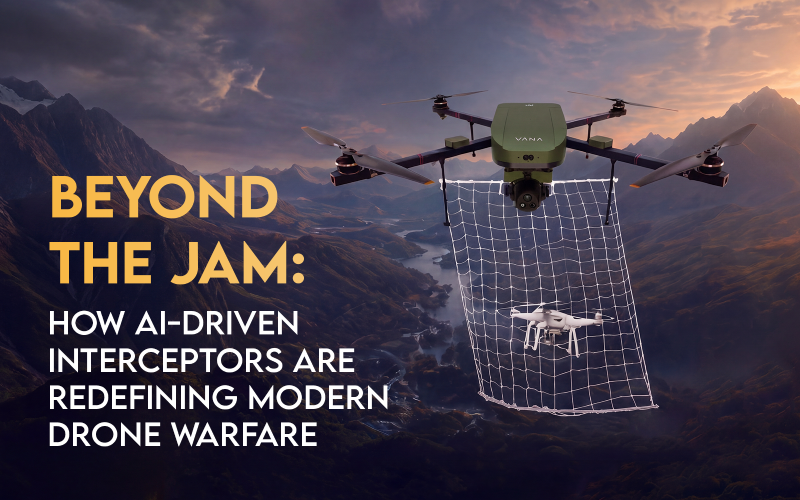
There was a time when electronic warfare felt like an invisible shield.
Jam the signal. Break the link. Ground the drone.
For years, this was enough.
But modern conflict has a way of exposing assumptions. And in today’s aerial battlespace, one
assumption is quietly collapsing. The idea that you can stop a drone simply by silencing it.
That era is ending.
The Cost Asymmetry Nobody Can Ignore
One of the most uncomfortable realities in modern defence is economic, not technological.
A missile system worth millions is often deployed to neutralise a drone that costs a fraction of
that. The math does not hold. It never did.
This imbalance is no longer theoretical. It is visible in active conflict zones where low-cost
loitering munitions are forcing high-value air defence systems into unsustainable engagement
cycles.
The response is beginning to shift.
Instead of countering mass with precision, defence systems are now moving toward countering
mass with mass. Interceptor UAVs are emerging as a practical layer of defence. Affordable,
scalable, and designed to operate in numbers rather than as isolated assets.
It is a different philosophy. One that aligns cost with consequence.
When Jamming Stops Working
Traditional electronic warfare has always relied on disruption.
Break the GPS signal. Interfere with communication links. Render the drone blind or
unresponsive.
But what happens when the drone does not need to listen?
Modern aerial threats are increasingly autonomous. Pre-programmed flight paths, onboard
navigation systems, and even fibre-optic tethering are removing the dependency on external
signals.
A drone that does not rely on communication cannot be jammed in the conventional sense.
In these environments, electronic warfare loses its edge. When there is no signal to disrupt, the
entire logic of soft kill begins to fail.
This is where the conversation changes.
Not towards better jamming, but towards something far more definitive.
Interception.
Operating When the Signal Disappears
If the future of aerial conflict is signal-denied, then survival depends on independence.
This is where the technical core of modern interceptor systems becomes critical.
Navigation is no longer just about GPS. Systems are now being built around visual inertial
odometry. In simple terms, the drone sees the world and understands how it is moving through
it. Cameras and inertial sensors work together to estimate position, even when satellites are
unavailable.
This creates a form of assured navigation. A concept often referred to as PNT resilience.
Position, navigation, and timing that continues even when external inputs are degraded or
entirely removed.
Then comes decision making.
Edge AI has moved from being an experimental layer to an operational necessity. Instead of
sending data back to a ground station for analysis, the drone processes it onboard. It identifies
targets, filters noise, and executes decisions in real time.
Once a target is identified, the system transitions into terminal guidance. The drone no longer
needs instructions. It knows what to follow.
Communication still matters, but its role changes. Secure links using frequency hopping and
encrypted channels are used during deployment and coordination. After that, autonomy takes
over.
This is not redundancy. It is design.
The Hunter Seeker Model
Modern interceptor operations are starting to resemble a structured workflow rather than a
reactive response.
Detection begins at the system level. Radar, acoustic sensors, or integrated command networks
identify an incoming threat.
Launch follows quickly. The interceptor is deployed toward a predicted zone rather than an
exact point.
Search and lock is where the intelligence layer comes alive. The drone scans its environment,
identifies the target, and distinguishes it from clutter.
Then comes the final phase. The intercept.
This is often executed through high-speed manoeuvres where agility and response time matter
more than raw speed. The goal is not to chase endlessly but to close decisively.
It is a shift from control to intent. From piloting to execution.
The Rise of Kinetic Shields
What we are beginning to see is the emergence of what can be described as a kinetic layer of
defence.
Instead of relying purely on electronic disruption, systems are being designed to physically
neutralise threats. This creates a protective envelope that is active, adaptive, and scalable.
In technical terms, this sits within the broader framework of electronic counter countermeasures.
Not just resisting interference, but operating effectively despite it.
For countries investing in indigenous capability, this shift is particularly significant.
Across India, there is a visible move toward building modular aerial platforms that are not
confined to a single role. These systems are designed to transition between surveillance,
mapping, inspection, and increasingly, tactical applications.
The logic is simple. One core platform. Multiple mission configurations. Consistent performance
across environments.
In such systems, resilience is not a feature. It is the foundation.
Autonomy as the Final Advantage
The conversation around drone warfare often focuses on speed, payload, or range.
But the defining factor is quietly becoming something else.
Independence.
A system that can navigate without GPS, identify without supervision, and act without constant
communication is fundamentally different from one that cannot.
By 2026, the edge will not belong to the fastest drone in the sky. It will belong to the one that
continues to function when everything else stops.
Autonomy is no longer an enhancement.
It is survival.