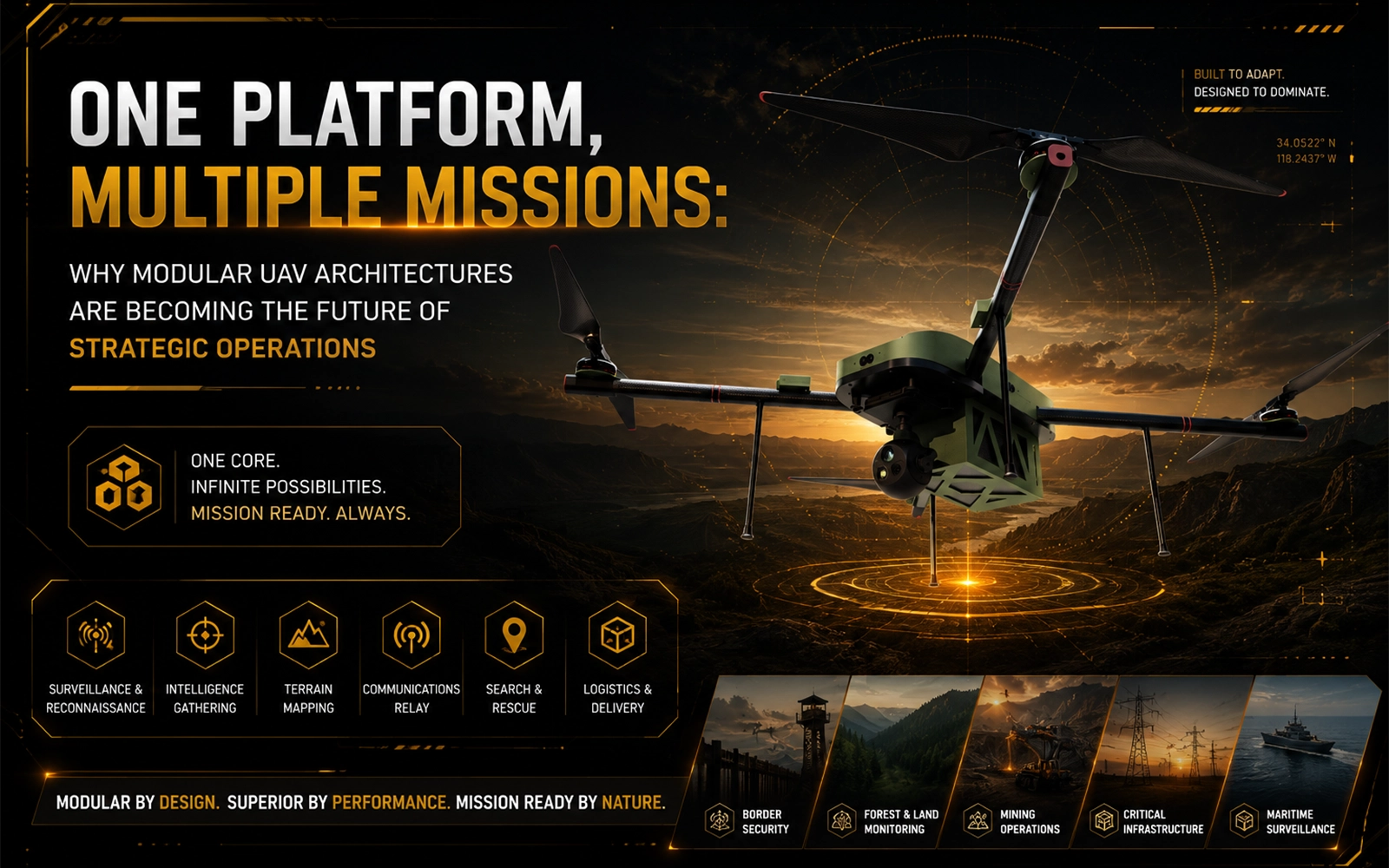
There is a quiet shift happening in the UAV industry, it may be conspicuous to the players that are part of the ecosystem, but it may fly under the radar for others.
Silos and singularity is what defined drones for many years. They had specialized functionalities. One platform for surveillance. Another for mapping. A different one for inspection. Yet another for agriculture. Every new operational requirement often meant introducing an entirely new system into the ecosystem.
At first, this seemed manageable.
But as aerial operations expanded across industries, the limitations of this model became impossible to ignore. Organizations were no longer just buying drones. They were inheriting maintenance complexity, retraining cycles, fragmented workflows, incompatible payload systems, and rising operational costs.
The real problem was not in the drone itself.
It was in the architecture behind it.
Today, governments, infrastructure operators, security agencies, and industrial organizations are beginning to move toward a different philosophy altogether. Instead of building fleets around isolated use cases, they are shifting toward modular UAV platforms designed to adapt across missions while retaining a common operational core.
In many ways, this transition is redefining what modern aerial capability actually means.
The End of the Single Purpose Drone
Modern operational environments rarely stay confined to one requirement.
A drone deployed for railway corridor monitoring may also be required for bridge inspection, accident documentation, or perimeter surveillance. A platform initially configured for mapping may later need multispectral capability for environmental assessment. Security operations may require rapid switching between EO, IR, and ranging systems depending on visibility and mission objectives.
This is where traditional drone ecosystems begin to break down.
Single-purpose systems often create operational silos. Different pilots need different training. Spare inventories become fragmented. Maintenance workflows multiply. Data pipelines become inconsistent.
Over time, scalability becomes difficult.
A modular architecture solves this differently.
Instead of redesigning the airframe every time the mission changes, the platform evolves through payload adaptability, software-driven workflows, and configurable mission modules. The drone remains familiar. The mission changes.
That distinction matters more than most organizations initially realize.
Why Standardized Airframes Matter
In high-frequency operational environments, predictability becomes a strategic advantage.
Pilots should not need to relearn flight behaviour every time a payload changes. Ground teams should not require entirely different deployment procedures across departments. Maintenance crews should not be forced to manage unrelated spare ecosystems for every operational requirement.
Standardized airframes reduce this friction.
A single platform architecture allows organizations to scale operations while maintaining consistent training logic, deployment methods, command workflows, and maintenance practices.
This becomes especially important in government and industrial deployments where long-term operational continuity matters more than isolated demonstrations of capability.
Increasingly, modern UAV ecosystems are being designed around this exact philosophy. One aerial core capable of supporting ISR operations, inspection workflows, mapping missions, logistics deployment, and environmental intelligence through modular payload systems.
The goal is not simply versatility.
It is operational sustainability.
The Rise of Payload Driven Operations
Payloads are quietly becoming the defining layer of modern UAV capability.
The drone itself provides endurance, navigation, stability, and communication infrastructure. But the mission is determined by what the platform carries.
An EO payload enables real-time visual inspection. Thermal systems introduce night operations and heat signature analysis. LiDAR allows terrain reconstruction and volumetric intelligence. Multispectral systems transform aerial platforms into agricultural analytics tools capable of NDVI and NDRE assessment.
What once required entirely separate systems can now exist within a unified aerial ecosystem.
This shift has major implications.
For infrastructure agencies, it means the same UAV architecture can inspect transmission lines, monitor railway corridors, and generate terrain data for future expansion planning.
For defense and security organizations, it enables rapid transition between surveillance, reconnaissance, and tactical observation missions without changing the underlying flight ecosystem.
For agriculture and environmental monitoring, it creates repeatable data workflows across large geographical regions with reduced manual intervention.
The future of aerial operations is no longer platform-centric.
It is payload-centric.
Why Endurance Is Becoming a Strategic Metric
One of the most underestimated aspects of modern UAV operations is endurance.
Most conversations around drones still revolve around speed or camera quality. But real-world deployments often depend more heavily on persistence.
A drone inspecting a long railway corridor cannot afford constant battery cycling. Border surveillance missions require extended loiter capability. Mapping large terrain segments demands stable and uninterrupted flight windows.
This is why endurance is increasingly becoming a defining metric in enterprise UAV adoption.
Long-endurance aerial platforms reduce deployment interruptions, improve operational coverage, and allow teams to complete larger missions with fewer launches.
The advantage is not merely technical.
It is logistical.
In industries where deployment conditions are difficult, response time matters, and operational windows are limited, longer endurance directly translates into higher mission efficiency.
Building for Indian Operational Conditions
One of the realities often overlooked in UAV discussions is geography.
India presents some of the most diverse operating conditions for aerial systems anywhere in the world. High temperatures, dust-heavy industrial zones, mountainous terrain, dense urban environments, coastal humidity, and long infrastructure corridors all place different demands on aerial platforms.
This is where modular indigenous systems gain significant relevance.
Platforms designed around Indian operational realities are naturally better positioned to adapt to local deployment requirements, regulatory conditions, communication challenges, and maintenance ecosystems.
Across the country, a new generation of drone startups and aerial technology companies are now building platforms that prioritize adaptability rather than rigid specialization. Systems capable of integrating ISR payloads, multispectral sensors, LiDAR modules, EO and IR surveillance systems, secure communication links, and autonomous mission workflows into a common operational architecture.
This approach is gradually reshaping how institutions think about aerial capability.
Not as a collection of separate drones.
But as a scalable aerial ecosystem.
The Future Will Belong to Flexible Systems
The next phase of UAV evolution will not be defined by who builds the most drones.
It will be defined by who builds the most adaptable ones.
Organizations no longer want isolated flying hardware. They want aerial systems that can evolve alongside operational requirements. Platforms that remain deployable across industries, departments, and mission profiles without constantly rebuilding infrastructure from scratch.
This is where modular UAV architecture changes the conversation entirely.
Because in modern operations, flexibility is no longer an added advantage.
It is the architecture itself.