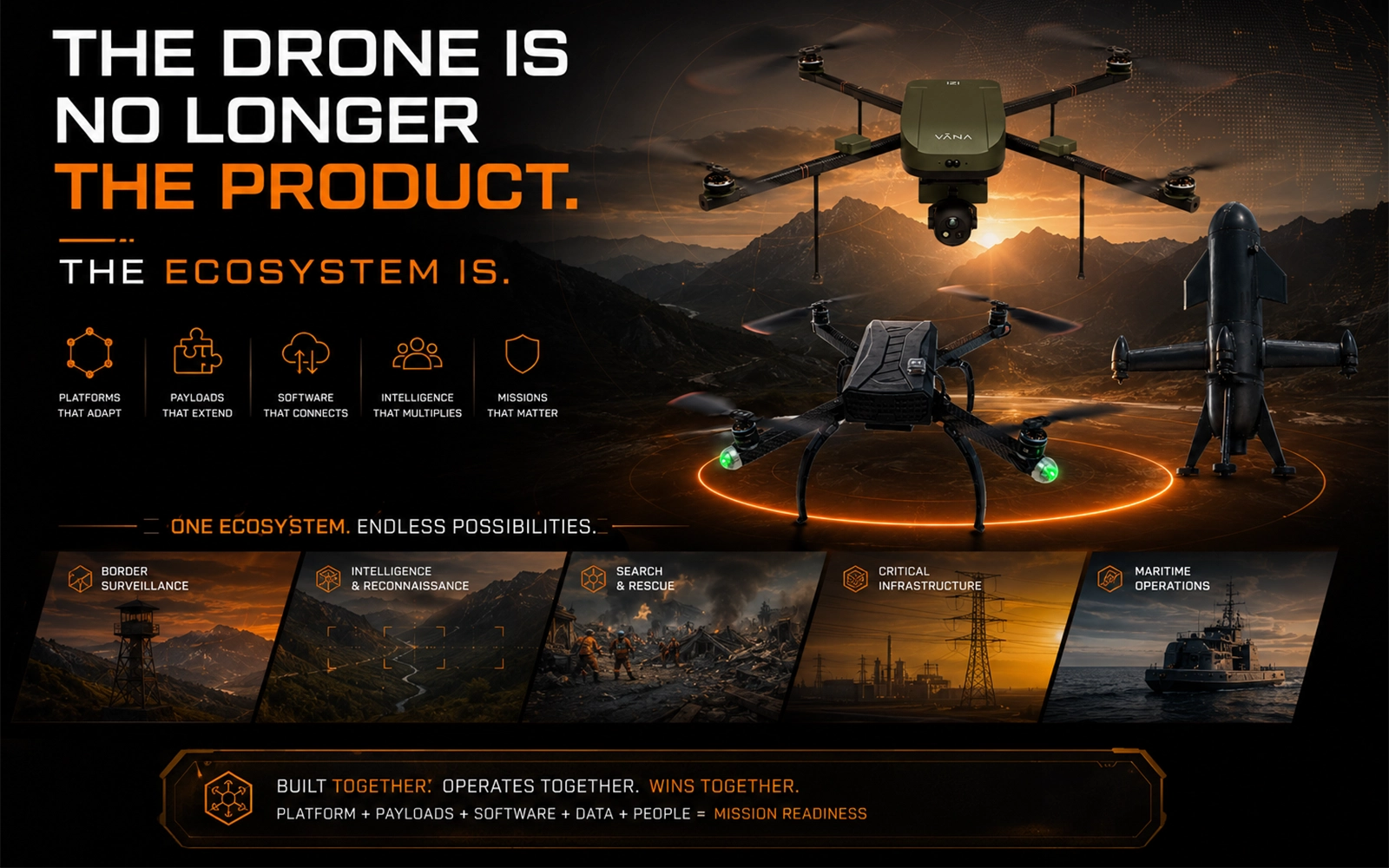
Aerial capability is no longer defined by what flies. It is defined by everything that enables it.
For years, conversations around unmanned aerial systems have followed a familiar checklist.
How far can it fly?
How long can it stay airborne?
How much weight can it carry?
What camera does it use?
How accurately can it navigate?
These questions remain important. They define the physical capabilities of a platform and determine whether it can complete a mission.
But they no longer tell the whole story.
Modern aerial operations have evolved beyond the aircraft itself. Today’s missions depend on a connected ecosystem where intelligence, software, communication, autonomy, and mission planning are just as important as the airframe in the sky.
The drone is still the most visible part of the mission.
It is simply no longer the product.
Every Mission Begins Long Before Takeoff
A successful UAV mission starts well before the motors spin.
Mission objectives are defined. Flight paths are planned. Payloads are selected. Airspace is assessed. Communication channels are secured. Teams prepare for contingencies before the aircraft ever leaves the ground.
Once airborne, the aircraft becomes one element within a much larger operational workflow.
Ground control stations monitor live telemetry. Operators receive video feeds and sensor data in real time. Artificial intelligence assists with detection and classification. Data is transmitted securely, analysed, archived, and transformed into actionable intelligence for decision-makers.
The value of the mission is therefore not determined by flight alone.
It is determined by how efficiently every component of that ecosystem works together.
Modern Defence Requires Systems, Not Standalone Platforms
The nature of defence operations has changed dramatically over the last decade.
Today’s missions demand flexibility across surveillance, reconnaissance, infrastructure inspection, logistics, disaster response, and border security.
No single aircraft configuration can meet every requirement.
Instead, defence organisations increasingly look for adaptable systems that can evolve alongside operational demands.
A platform inspecting transmission lines today may be deployed for disaster assessment tomorrow. A surveillance mission may later require thermal imaging, mapping, or long-range reconnaissance.
Replacing entire aircraft for every new requirement is neither practical nor sustainable.
Modular architecture offers a different approach.
Rather than building a new platform for every mission, operators configure the same platform with the payload, sensors, and workflows required for the task at hand.
The result is greater operational flexibility, lower lifecycle costs, simplified training, and faster deployment.
This shift is redefining how modern UAV ecosystems are designed.
Intelligence Has Become the Real Payload
For many years, payload discussions centred on cameras.
Higher resolution.
Greater zoom.
Better thermal imaging.
Those capabilities remain essential, but they are only the beginning.
Today’s missions generate enormous volumes of information. Collecting data is relatively straightforward. Extracting meaningful insight from that data is where real capability now exists.
Artificial intelligence is steadily transforming aerial operations by assisting with target recognition, anomaly detection, route optimisation, sensor fusion, and mission analysis.
The objective is no longer to provide operators with more information.
It is to provide the right information at the right moment.
This transition from data collection to decision support represents one of the most significant changes taking place across the UAV industry.
The Invisible Infrastructure Matters Just as Much
Some of the most important components of a UAV ecosystem are rarely visible.
Secure communication links.
Mission planning software.
Navigation resilience.
Encrypted command and control.
Flight data management.
System diagnostics.
Predictive maintenance.
These capabilities rarely appear on product specification sheets, yet they determine how reliably a platform performs when operating in demanding environments.
A sophisticated sensor becomes far less valuable if communication is interrupted.
An autonomous mission loses effectiveness without resilient navigation.
High-performance hardware cannot compensate for fragmented workflows or disconnected operational systems.
As UAV deployments become increasingly mission-critical, the supporting ecosystem becomes just as important as the aircraft itself.
Why India Has a Rare Opportunity
India stands at an important point in the evolution of drone technology.
The country is not simply expanding its UAV manufacturing capability.
It is building the opportunity to develop complete indigenous aerial ecosystems.
This distinction is significant.
True technological capability is created when research, software, hardware, manufacturing, payload integration, secure communication, operational support, and future upgrades are developed within a unified framework.
Such ecosystems reduce dependence on external supply chains while enabling faster innovation and long-term operational continuity.
They also create platforms that can be continuously refined to address India’s unique operational environments, regulatory frameworks, and strategic priorities.
This is where long-term technological leadership is built.
Why IZI Enterprise Is Building Beyond the Aircraft
At IZI Enterprise, our approach to VANA has always extended beyond designing an aircraft.
From the beginning, the objective has been to create a modular aerial ecosystem capable of adapting to evolving operational requirements rather than serving a single mission profile.
Today, VANA supports applications ranging from surveillance and infrastructure inspection to mapping, environmental monitoring, training, and strategic operations through a common platform architecture.
Its modular payload philosophy, configurable mission profiles, secure communication framework, AI-assisted capabilities, and future-ready roadmap reflect a broader belief.
The future of aerial systems will not be defined by isolated specifications.
It will be defined by intelligent ecosystems capable of evolving alongside the missions they support.
As new technologies such as GPS-denied navigation, advanced autonomy, tethered operations, frequency hopping communication, swarm coordination, and intelligent mission management continue to mature, the ecosystem surrounding the aircraft will become its greatest strength.
The Next Generation of UAVs Will Be Defined by What Connects Them
History often remembers the machines that changed an industry.
Less often does it remember the systems that made those machines indispensable.
The future of aerial technology will not belong solely to platforms with longer endurance or larger payloads.
It will belong to platforms supported by resilient communication, adaptable architectures, intelligent software, secure data, modular engineering, and continuous innovation.
The drone will always remain the visible face of the mission.
But increasingly, the ecosystem behind it will determine its true capability.
For organisations building the next generation of aerial intelligence, the objective is no longer to create better aircraft.
It is to create better systems.
And in the years ahead, those systems will define the future of unmanned aviation.