Modern defence is changing.
Not because warfare has become more unpredictable, but because technology has become more interconnected.
A surveillance mission today is no longer dependent on a single aircraft. It depends on communication networks, navigation systems, software updates, payload integration, maintenance cycles, supply chains, batteries, sensors, encryption protocols, and the ability to keep all of these systems operational when they are needed most.
In such an environment, national security extends far beyond what is visible in the sky.
It begins with what exists on the ground.
The question is no longer whether a country possesses advanced unmanned aerial systems.
The more important question is whether those systems can continue to evolve, adapt, and remain operational without depending on external ecosystems.
For India, this conversation has never been more relevant.
Defence Capability Begins with Technological Independence
For decades, countries have acquired defence equipment from global manufacturers to bridge capability gaps.
These partnerships have contributed significantly to modernization, but they have also highlighted an operational reality.
Critical defence platforms are only as reliable as the supply chains that support them.
During periods of geopolitical uncertainty, export restrictions, delayed component availability, software licensing limitations, or maintenance dependencies can influence operational readiness far more than the platform itself.
This is why defence planners across the world are investing not only in advanced equipment but also in indigenous capability.
Building technology domestically creates control over development, production, servicing, upgrades, and long-term deployment.
It transforms procurement into capability ownership.
Modern Warfare Demands Adaptable Systems
Today’s missions rarely remain static.
A UAV deployed for border surveillance may later support disaster response.
An inspection platform may be reconfigured for infrastructure security.
A reconnaissance asset may require new payloads, updated communication systems, or improved navigation as operational demands evolve.
Platforms designed around modular architecture provide this flexibility.
Rather than replacing entire systems, operators can upgrade mission capabilities through payload integration, software enhancements, and mission-specific configurations.
This reduces operational disruption while extending the lifecycle of valuable assets.
It also allows defence organizations to respond faster to changing mission requirements without rebuilding their aerial ecosystem from the ground up.
Why Indigenous Innovation Matters
Building UAVs within India is about far more than manufacturing.
It is about engineering platforms around Indian operational realities.
From Himalayan terrain and coastal surveillance to dense urban environments and critical infrastructure, India’s security landscape presents challenges that cannot always be addressed through generic global solutions.
Indigenous research allows engineers to optimise systems for these realities.
Communication resilience.
Mission endurance.
Environmental adaptability.
Payload flexibility.
High-altitude performance.
Electronic warfare resilience.
Each improvement is driven by operational understanding rather than adaptation after deployment.
This creates systems that are not simply assembled in India, but designed with India in mind.
Building an Ecosystem, Not Just a Drone
One of the most significant shifts taking place within India’s UAV industry is the move from individual products toward integrated aerial ecosystems.
The future belongs to platforms that combine secure communication, modular payload architecture, autonomous mission planning, AI-assisted decision support, and scalable fleet deployment into a unified operational framework.
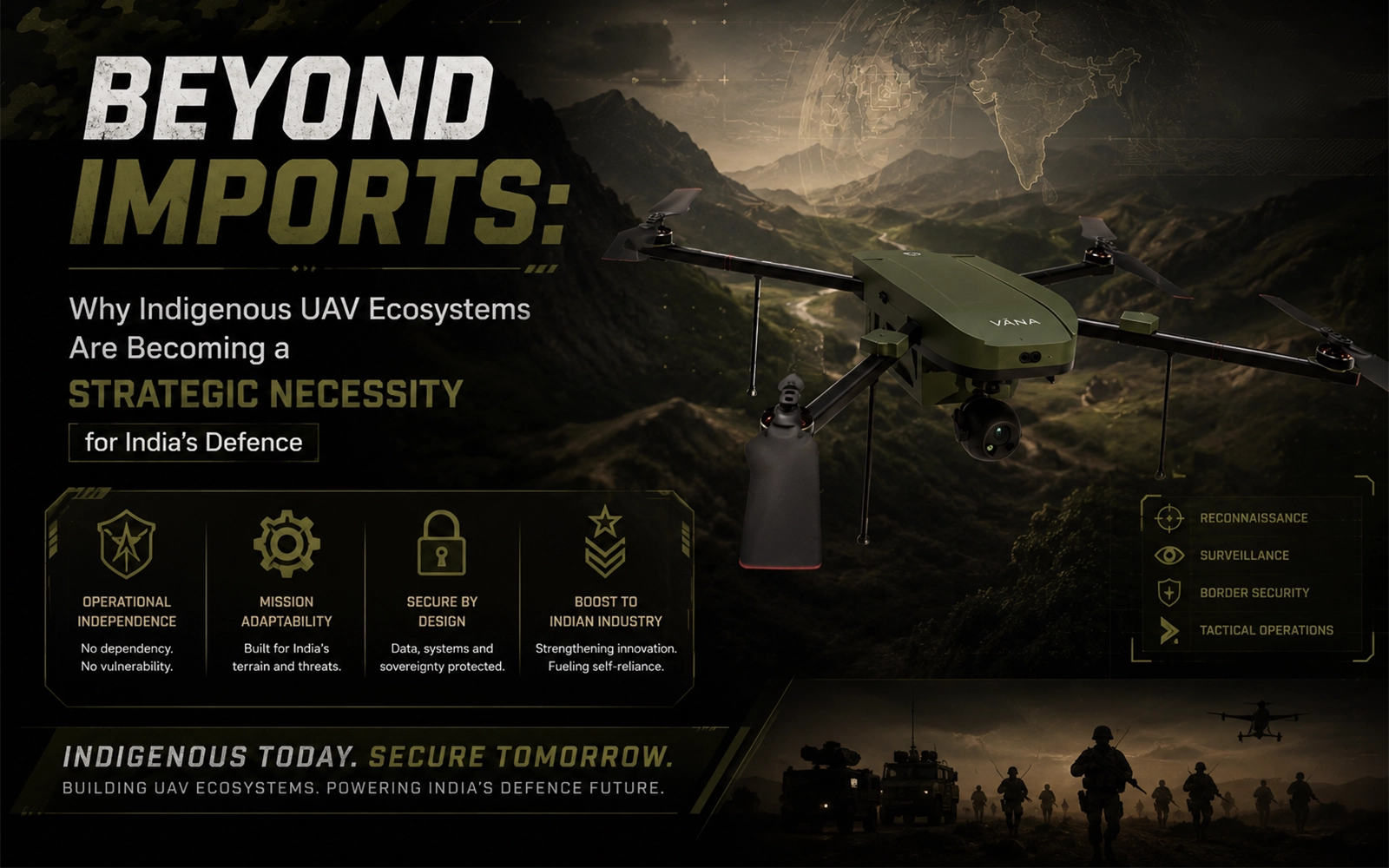
At IZI Enterprise, this philosophy has shaped the evolution of the VANA platform.
Designed as a modular UAV ecosystem rather than a single-purpose aircraft, VANA supports surveillance, mapping, inspection, logistics, and strategic missions through configurable payloads and standardized architecture.
Its development reflects a broader industry transition.
Success is no longer measured only by flight performance.
It is measured by how effectively a platform can evolve alongside operational requirements.
Investing in Capability That Stays Home
Every indigenous platform contributes beyond the immediate mission.
It strengthens engineering talent.
It expands manufacturing capability.
It creates resilient supply chains.
It accelerates research.
It shortens development cycles.
Perhaps most importantly, it ensures that future upgrades remain within national control rather than external dependency.
As India continues to modernize its defence capabilities, investment in homegrown UAV technology represents more than industrial growth.
It represents strategic continuity.
The Road Ahead
The future of defence will increasingly be defined by intelligent aerial systems capable of adapting to rapidly changing operational environments.
Countries that build these systems domestically will possess an advantage that extends beyond technology itself.
They will possess the ability to innovate without waiting.
To upgrade without dependence.
To deploy without uncertainty.
For India, indigenous UAV development is therefore not simply a manufacturing objective.
It is a long-term investment in operational resilience, technological confidence, and strategic autonomy.
As the next generation of aerial platforms emerges, the greatest strength may not lie in who builds the fastest drone.
It may lie in who owns the knowledge, the ecosystem, and the ability to keep that platform mission-ready for decades to come.