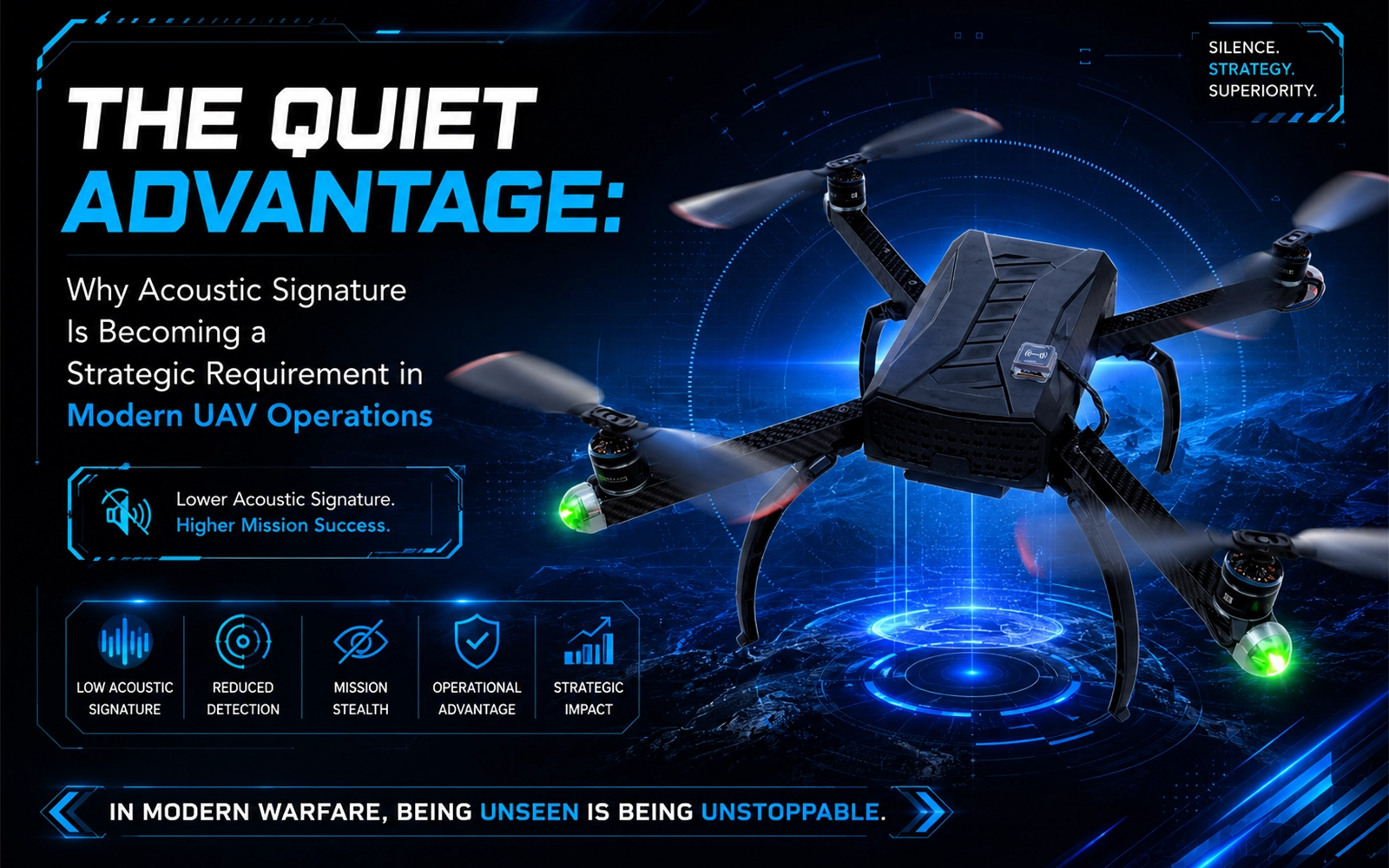
When discussions around unmanned aerial systems take place, the conversation usually revolves around familiar metrics.
Range.
Endurance.
Payload capacity.
Optical zoom.
Thermal sensors.
Communication links.
These specifications are important. They define what a platform can do and how effectively it can perform a mission.
Yet one of the most operationally significant characteristics of a UAV often receives far less attention.
Sound.
For decades, the effectiveness of an aerial platform has largely been measured by what it can see. Increasingly, however, mission success is also being influenced by what the platform allows others to hear.
Across defence, public safety, wildlife monitoring, and infrastructure inspection, acoustic signature is emerging as a critical performance parameter that directly impacts operational outcomes.
The most effective drone is not always the one carrying the largest payload or flying the farthest distance.
Sometimes, it is the one that enters an environment without announcing its presence.
Why Acoustic Signature Matters
Every drone creates sound.
Propellers displace air. Motors generate vibrations. Structural components transfer energy throughout the airframe. Together, these factors create the acoustic footprint of the platform.
In many missions, this is merely a technical characteristic.
In others, it becomes a decisive operational variable.
A wildlife monitoring mission can be compromised when animal behaviour changes in response to aerial noise.
A surveillance operation can lose its effectiveness if the target becomes aware of aerial observation before data collection is complete.
Urban deployments may create unnecessary attention in densely populated environments.
Infrastructure inspections near critical facilities often benefit from platforms that can perform their task with minimal disturbance.
The challenge is not simply reducing noise.
The challenge is reducing noise without compromising stability, endurance, payload capability, or operational reliability.
That is where engineering begins to matter.
The Relationship Between Vibration and Visibility
Many people assume quieter drones are simply equipped with quieter motors.
In reality, acoustic performance begins much deeper within the platform architecture.
Sound is often a by-product of vibration.
Every structural oscillation within the airframe contributes to the overall acoustic signature of the system. Excessive vibration also affects image quality, flight stability, sensor accuracy, and long-term component reliability.
As a result, reducing vibration becomes about much more than improving operator comfort.
It becomes a pathway toward better operational performance.
Within IZI Enterprise’s VANA platform, significant focus has been placed on optimizing airframe geometry, propulsion efficiency, and structural balance to minimize vibration across the flight envelope.
The result is not only improved stability for surveillance and inspection missions but also a measurable reduction in acoustic presence during operation.
In practical terms, a more stable drone often becomes a quieter drone.
Why Quiet Platforms Matter in Defence Operations
Modern defence operations are increasingly dependent on persistent aerial intelligence.
Border monitoring, tactical reconnaissance, convoy overwatch, target observation, and ISR missions often require aircraft to remain present for extended periods while minimizing detectability.
Visual detection is only one aspect of exposure.
Acoustic detection frequently occurs much earlier.
Human observers often hear an aircraft before they see it. In low-visibility environments, sound may become the primary indicator of aerial activity.
For this reason, acoustic management is becoming an increasingly important design consideration for reconnaissance and surveillance platforms worldwide.
A lower acoustic signature does not make a UAV invisible.
It simply provides operators with greater flexibility, reduced observational disruption, and improved mission effectiveness.
When combined with secure communication links, advanced sensors, and autonomous mission workflows, acoustic optimization becomes part of a larger operational advantage.
Beyond Defence: The Civilian Impact
The importance of acoustic performance extends far beyond security applications.
Across India, UAV deployments are rapidly expanding into sectors such as agriculture, railways, power utilities, environmental monitoring, disaster management, and smart city operations.
These deployments often occur close to populated areas, active work sites, ecological zones, and sensitive infrastructure.
A platform that generates excessive noise can create resistance from stakeholders, attract unnecessary attention, or disrupt the environment it is intended to monitor.
Conversely, quieter systems allow operations to integrate more naturally into existing workflows.
This becomes especially relevant as UAV adoption scales across government departments and enterprise organizations.
Future aerial platforms will not only be evaluated by their capabilities.
They will also be evaluated by how seamlessly they can operate within real-world environments.
Engineering for Operational Reality
At IZI Enterprise, conversations around UAV development increasingly focus on operational outcomes rather than isolated specifications.
The question is rarely whether a platform can fly.
The more important question is whether it can perform consistently across varied environments while supporting the needs of operators on the ground.
This philosophy has shaped the development of VANA as a modular aerial platform capable of supporting surveillance, inspection, mapping, environmental monitoring, and strategic operations through a common architecture.
Within that architecture, flight stability, vibration management, endurance, payload adaptability, and acoustic performance are interconnected design priorities rather than independent features.
Specialized low-noise propeller configurations further extend these advantages, enabling quieter operation in environments where discretion, safety, or minimal disruption are important considerations.
The objective is not simply to create a drone that performs well in demonstrations.
The objective is to create a platform that performs predictably in the field.
The Future of UAV Design May Be Quieter Than We Expect
For years, UAV development has been driven by a race for larger payloads, longer endurance, and more advanced sensors.
Those capabilities will continue to matter.
But the next generation of aerial platforms will increasingly be judged on how intelligently they integrate into operational environments.
Acoustic signature is becoming part of that equation.
As UAV systems expand into more complex industrial, governmental, and security applications, quieter operation will no longer be viewed as a secondary benefit.
It will become a strategic requirement.
At IZI Enterprise, we believe the future of aerial systems lies not only in what they can achieve, but in how efficiently, reliably, and unobtrusively they can achieve it.
Sometimes the most capable platform in the sky is not the loudest one.
It is the one that allows the mission to remain the focus.